Storm chasers and local contractors: what to check before anyone touches your roof
Five checks separate storm chasers from local contractors before anyone gets on a ladder, and why Texas does not issue a state license for roofing contractors.
By EV Roofing & Construction
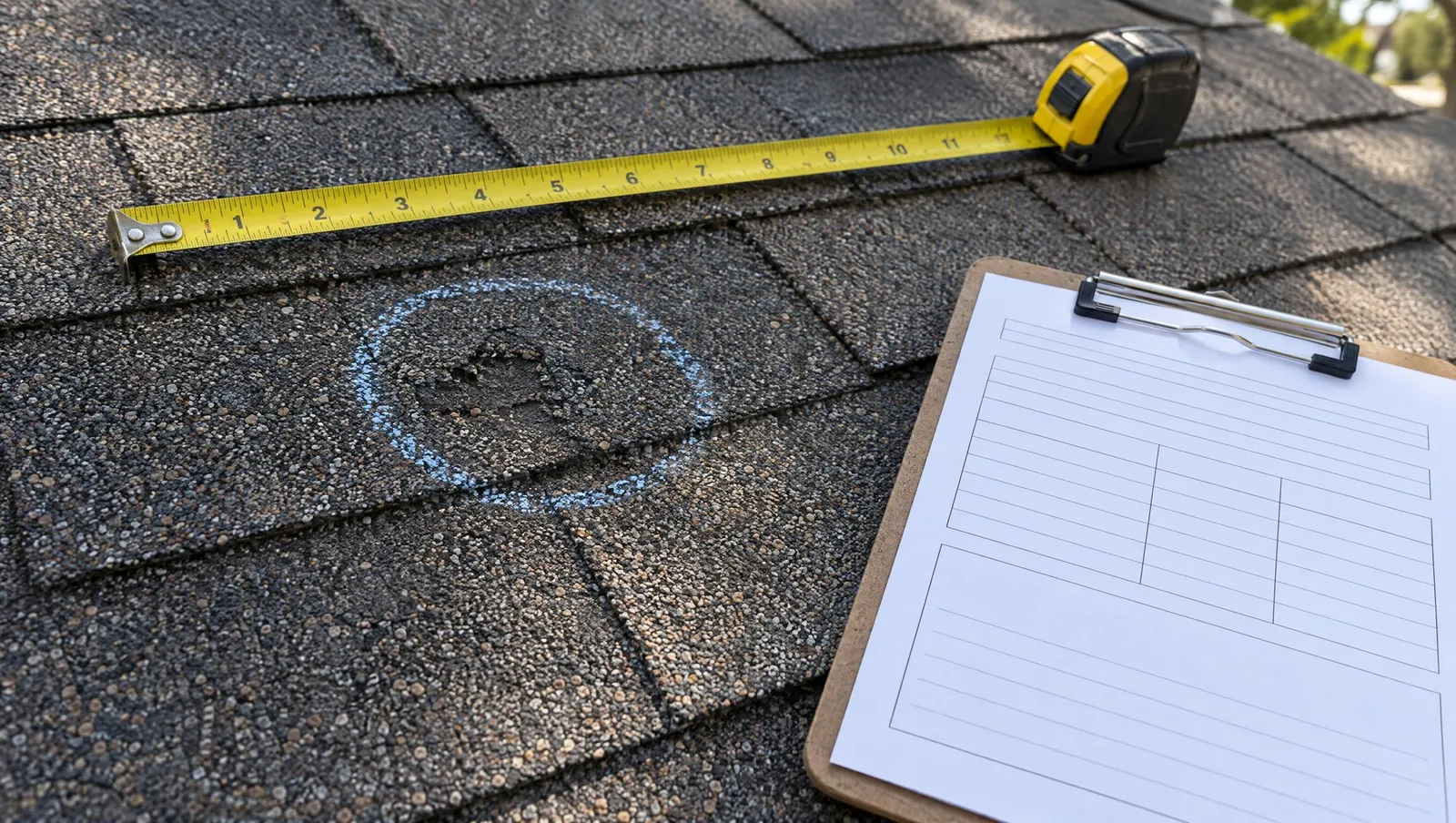
After a significant storm, out of town crews arrive in the Brazos Valley within days. Some are competent operations working a legitimate surge. Others will not be reachable in eighteen months. From your driveway, on the day, the two are difficult to tell apart, because both arrive in a clean truck with a folder.
Here is the short version. Five checks separate them, and all five can be done before anyone gets on a ladder: confirm a real local presence, require proof of insurance sent to you directly by the insurer or agent, ask which manufacturer certifications the company actually holds, get the workmanship warranty in writing along with the name of who honors it, and read the reviews on one platform rather than a screenshot.
There is a sixth thing, and it is the one almost nobody knows.
Texas does not issue a state license for roofing contractors
This surprises most homeowners, and it changes how you read every credential you are shown.
The Roofing Contractors Association of Texas states the position plainly: “The Texas Department of Licensing & Regulation (TDLR) does NOT currently administer licensure for roofing contractors.” RCAT goes further about what that means in practice, writing that “Anyone can call themselves a roofer in Texas and they are not required to be knowledgeable, insured, licensed, or even registered with the state.”
RCAT runs a voluntary program of its own, and is careful to say what it is. In their words, the credential is “provided through and fully managed by the Roofing Contractors Association of Texas,” which is a trade association rather than a government agency.
So the practical takeaway is this. When a company leads with a claim about a Texas roofing license, that claim is not doing the work you assume it is doing. It may refer to a voluntary trade program, a city registration for pulling permits, or nothing at all. It is not a state qualification, because there is no state qualification to hold. Ask what specifically is meant, and then move on to the credentials that can actually be verified.
The five that can be verified
1. A real local presence
Not only a phone number and a truck. Ask where the office is and for local jobs you can drive past. A local company is still here if something comes up two years from now. Our office is in Bryan, and our number is (979) 406-5431. You can read who we are and what we can show you before you call.
2. Proof of insurance, sent to you by the insurer
Ask for a certificate of insurance sent directly from the agent or carrier to your email, with you named as a certificate holder. A PDF handed to you at the door proves considerably less. What you are looking for is general liability and workers compensation both in force, because if a crew member is hurt on your property and the company carries no workers compensation, that exposure does not simply evaporate. EV is fully insured, carrying general liability and workers compensation.
3. Manufacturer certifications
Certifications are issued by manufacturers to companies that meet their installation and business standards, and they can be checked with the manufacturer rather than taken on trust. EV is Owens Corning certified and GAF certified, and our roofing types guide shows which systems we install. Certifications also tend to matter for what a manufacturer will stand behind, which is worth understanding before the work rather than after.
4. The workmanship warranty, in writing, with a name on it
A manufacturer warranty covers material. A workmanship warranty covers the installation, and it is only as good as the company standing behind it. Ask for the term, ask what it excludes, and ask who honors it if the company is sold. EV carries a 10 year workmanship warranty on roofing work, and the full warranty schedule is published.
5. Reviews, on one platform, read properly
Read them on a single source rather than a collage of screenshots, and read the recent ones and the negative ones rather than the average. What you are looking for is how the company behaved when something went wrong, because something eventually does. A company with an established local record also tends to carry a Better Business Bureau rating you can look up, and EV holds an A+.
Three things worth noticing on the day
Pressure to sign immediately. A legitimate contractor will let you read a contract overnight. Urgency is a sales technique, and after a storm it is the most effective one available.
Vagueness about the scope. The document should say what is being removed, what is going on, how penetrations and flashings are handled, and what happens if the decking underneath turns out to be compromised. If those answers are not in writing, they are not agreed. Our written inspection reports and how we bid a job show what that paperwork looks like.
An offer to cover your deductible. Texas law makes it illegal for a contractor to offer to waive, rebate or absorb your insurance deductible, and a roofer doing the work on your home cannot also act as your public adjuster on the claim. An offer like that is a reason to end the conversation, not a discount.
If you want a second opinion on something another company has proposed, the number is (979) 406-5431, every day except major holidays, 7:00am to 6:00pm, or you can send the details and photos.
Sources: Roofing Contractors Association of Texas, licensing, checked 5 October 2026. Texas Department of Insurance, Roofing and insurance: Know the law, checked 6 November 2026.
Questions
Call (979) 406-5431, every day except major holidays, 7am to 6pm. Hablamos español.